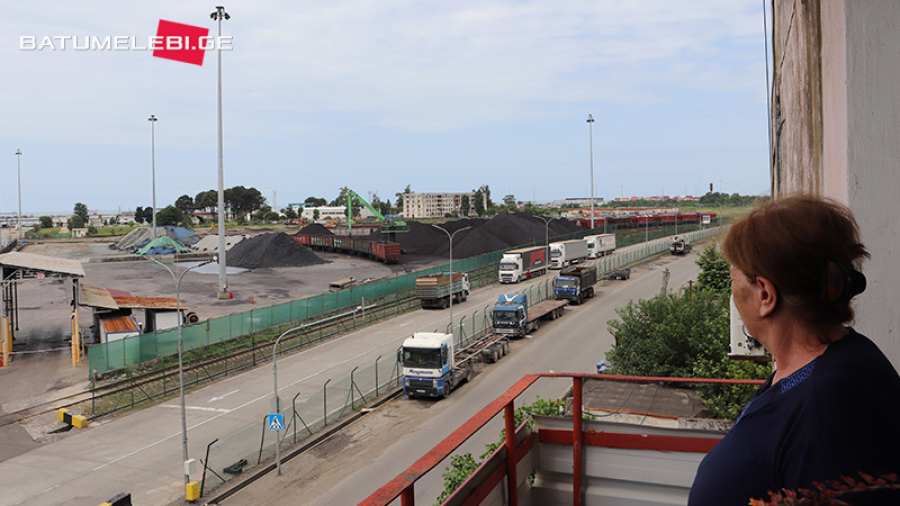
The Nabada district, which covers more than a quarter of the city in both area and population, is home to thousands of residents who are exposed daily to environmental and noise pollution from Georgia’s largest port complex. One of the main contributors is Transford LLC, which since 2019 has stored around one million tons of minerals and industrial raw materials — including copper and manganese concentrates, sulphur, clinker, and coal — in open-air conditions directly next to a residential area. Wind disperses toxic dust into nearby homes, causing serious health issues for children and adults. Around 100 families live in the closest vicinity, where dust from transport and the terminal settles in thick black layers on balconies, windows, and inside homes. Constant noise from arriving trucks further worsens living conditions. These families, displaced from Abkhazia more than 30 years ago due to civil war, have nowhere else to go and are therefore forced to remain in these dangerous conditions.
Lead in children’s blood sparks local outrage
To draw attention to the life-threatening conditions on Javakhishvili Street, residents founded the association - “Poti Citizens for Their Rights” in 2020. With the support of the Women's Fund, they had the blood and hair of twenty children from the most affected area tested; half of the samples showed lead levels above the legal limit. Based on these alarming results and a petition, the National Environmental Agency (NEA) installed a mobile station for 24-hour air quality monitoring in July 2020. The station confirmed the seriousness of the situation – the concentration of PM₁₀ and PM2.5 dust particles repeatedly exceeded the permitted limits.
Although the mobile monitoring station detected severe pollution, its operation was terminated by the National Environmental Agency on 22 January 2021. The agency cited strained relations with residents as the reason for the shutdown, which could have jeopardized its operation. The station remained out of service for more than 22 months before being moved to Tbilisi.
However, residents believed the station had been deliberately shut down due to alarming measurement results. Public trust in the agency’s work was also significantly undermined by the fact that air pollution data was only published for the period from June 20 to September 13, 2020. The website where the results were published was shut down shortly after.
Nevertheless, the published data led The National Centre for Disease Control and Public Health to recommend that the Poti City Hall begin systematically monitoring the health of residents in the most polluted areas. In 2021, the city council supported a larger study testing the amount of lead in the blood of children living around the Transford terminal. However, the study raised questions about its representativeness and expertise. The National Centre for Disease Control and Public Health – that is supposed to methodologically guide the expert studies – did not participate in the preparation of the survey. Doubts were also raised by the size of the sample of children analysed. A total of 104 children were tested – 52 of them came directly from Javakhishvili Street, while the other half came from the unpolluted recreational Maltakva district.
Despite methodological shortcomings, the study revealed that 28 children had blood lead levels above 5µg/dl, and in two children, lead concentrations even exceeded 10µg/dl. 14 children with blood lead concentrations above 5µg/dl lived at Javakhishvili and 30, opposite the Transford terminal. According to international recommendations, a level above 5µg/dl is considered elevated, and there is no safe concentration of lead in the blood. Values in the range of 5–10µg/dl can impair cognitive abilities and attention; above 10µg/dl already pose a serious health risk. Nevertheless, the final report described the overall condition of children in Poti as “satisfactory” and did not identify a demonstrable influence of heavy metals on their development. However, local parents and experts question this conclusion due to the problematic methodology and the limited sample of children tested.
Despite the alarming findings, the situation in Poti initially remained without a response from the relevant institutions. Transford denied all allegations, claiming that the company does not handle toxic materials and that its operations do not exceed any legal limits. It repeatedly referred to internal monitoring conducted by Gamma Consulting, a private environmental consultancy, the results of which it has never published.
Residents win relocation, but pollution continues
The people of Javakhishvili Street are trying to solve environmental problems in their neighbourhood through all available forms of civic engagement. They organize petitions, community meetings, hold demonstrations, and try to ensure that the public is constantly informed about the state of the air in the neighbourhood. On April 21, 2021, the Poti Citizens for their Rights filed a lawsuit with the city court, urging the local government and the Ministry of Environment and Agriculture to comply with environmental protection laws.
A few months after filing the lawsuit, Prime Minister Irakli Gharibashvili visited the residents of Javakhishvili Street and promised them financial compensation of $50,000 per family and relocation to a healthier environment. Following this, the state sold 7.7 hectares of land adjacent to the port and required the purchasing company to relocate 100 families living on the site to alternative housing, compensating them $700 per square meter. Thanks to their persistence, the residents were successfully relocated even without a court ruling, which remains unresolved by the end of 2025. However, no document mentions any “compensation to residents for inconvenience and harm to health.”
Nevertheless, the relocation alone has not solved the problems in the contaminated area. The construction and expansion of the port continue without changing the way bulk materials are handled. At least 3,000 families remain in the neighbourhood, with half of them at risk from noise and air pollution emanating from the port. The public authorities have not yet presented a clear plan for a solution, and the current conditions continue to harm the lives of local people.