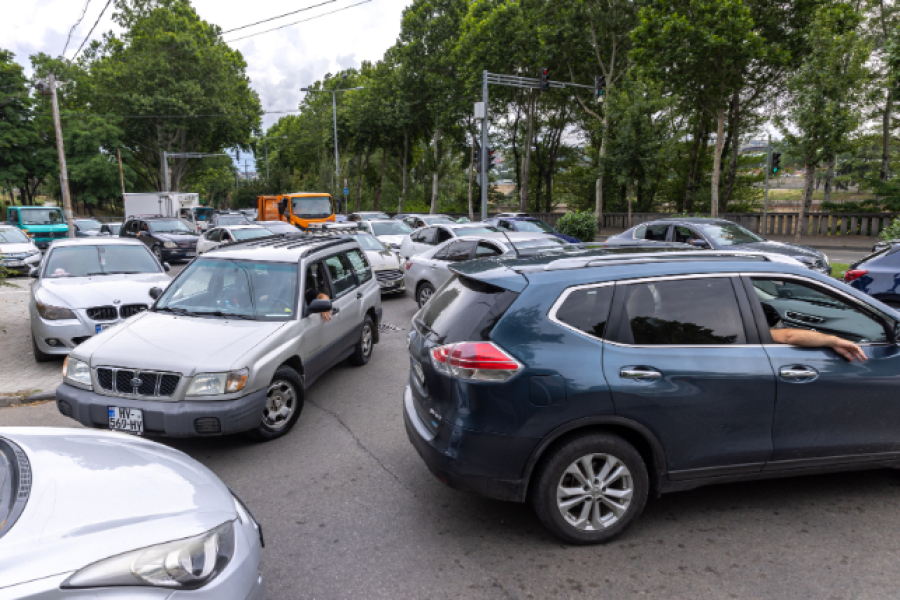
Sources and impacts of air pollution
It is estimated that up 90% of urban air pollution in Tbilisi originates from the transport sector. Private car ownership is growing every year - according to available data, 70,000 to 80,000 vehicles are added annually, with most of them being older models that do not meet up-to-date emission standards. In 2019, more than 90% of registered vehicles were older than ten years, using outdated technology, lacking modern emission control systems and filters, and failing to pass emissions inspections.
According to Davit Jaiani, Deputy Head of the Tbilisi Transport and Urban Development Agency, car owners in Georgia tend to rely on their vehicles far more intensively than in many other European countries. The absolute majority use their cars at least five days a week, which, combined with the prevalence of outdated vehicles, significantly increases concentrations of air pollutants such as nitrogen dioxide (NO₂) and carbon monoxide (CO).
Historically, public transport in Tbilisi has been insufficient and unreliable, which further encouraged residents to rely on the use of privately owned vehicles. Until recently, taking the bus was often a frustrating experience – services were infrequent, vehicles overcrowded, and breakdowns were common. This lack of a dependable public transport system pushed more people towards car ownership, amplifying the city’s air pollution problem.
A radical transformation of public transport began in 2018 to promote sustainable mobility. As part of this effort, the city replaced outdated vehicles with modern CNG-powered buses. Although dedicated bus lanes have also been introduced to improve reliability, they remain highly fragmented and discontinuous, limiting their overall effectiveness. In parallel, the city started developing cycling infrastructure to encourage more environmentally friendly modes of transport, and in some districts of the city, improves the pedestrian infrastructure and public spaces in general.
In addition to transport, other significant contributors to Tbilisi’s air pollution include household heating. During the winter months, the burning of coal and wood, leads to increased concentrations of NO₂ and particulate matter found in dust (PM10).
The chaotic construction boom of the new residential districts and office spaces, which fully took off in 2006, has become another major pollution source. This surge in development was largely driven by the government’s approach of actively promoting large-scale projects while removing regulatory restrictions associated with construction. Construction permits are being issued with minimal oversight, allowing new buildings to rise also in historic neighbourhoods and environmentally sensitive areas. This unregulated expansion has been fundamentally reshaping Tbilisi’s urban landscape.
In 2024, Tbilisi accounted for nearly half (46.8%) of all building permits issued in Georgia, underscoring the city’s rapid urban development. However, this fast-paced growth comes at a cost. Activities such as the dry cutting of construction stone release fine dust particles (PM10) into the air, contributing to respiratory diseases. Moreover, the scale of development is putting pressure on urban infrastructure. Residents report persistent traffic congestion, lack of green spaces and worsening living conditions in general.
The health consequences of air pollution in Tbilisi are alarming. According to the World Health Organisation (WHO), approximately 3,774 premature deaths occur in the capital each year due to exposure to polluted air. Pollutant concentrations in the city exceed WHO safety limits by up to three times.
Civic air pollution monitoring
Deteriorating air quality and insufficient state monitoring led to the creation of the civic campaign “My City Kills Me”; its Facebook page attracted over a quarter of a million followers and has become the public’s voice in the fight for cleaner air in Tbilisi.
Together with Arnika, Tbilisi-based NGO Green Pole founded the citizen science air pollution monitoring network: AirGE in 2023. Green Pole volunteers built and installed monitoring stations that help replace missing official data. By 2024, the network had grown to 100 measuring stations in 11 Georgian towns and cities. The stations measure concentrations of particulate matter (PM) and volatile organic compounds (VOCs). The measured data is published in real time on the website.
In addition to measuring air quality, in 2022 Green Pole launched the campaign for legislative changes that would prohibit the operation of vehicles exceeding emission limits. After collecting 30, 500 signatures and amendments to the draft by the Ministry of the Environment, the law was adopted and entered into force in July 2023, with emission monitoring starting in September 2023.
Protests against commercial development
However, air pollution is not the only consequence of poor urban management in Tbilisi. In the last twenty years, the city has been facing a chaotic construction boom that has triggered waves of civic resistance. The first large-scale protests erupted in 2010 in response to plans for a highway cutting through Mziuri Park, residential complexes in the Vere River valley, a hotel project in Vake Park, and the redevelopment of the historic Gudiashvili Square. Civic campaigns such as Save Mziuri, Protect Gudiashvili, and Saving Vake Park emerged to defend specific parts of the city from insensitive development projects.
The electoral victory of the Georgian Dream party in 2012 brought some partial successes for activists, including the preservation of Vake Park and Gudiashvili Square. However, the overall trend of poorly planned and controlled development continued. A major confrontation between the public and developers came in 2013 with the Panorama Tbilisi project; a luxury complex owned by influential businessman and Georgian Dream founder Bidzina Ivanishvili. The project was approved without transparent public participation, leading to the creation of the coalition Ertad (United), which organized a single but pivotal protest against the unchecked transformation of the city's historic character. Nevertheless, internal disagreements within the coalition prevented it from halting the construction. Today, Panorama Tbilisi’s main building prominently dominates the city centre.
Promises to protect public spaces were reiterated by Kakha Kaladze, who was elected mayor of Tbilisi in 2017. Upon taking office, Kaladze dissolved the Zoning Council, which had been criticized for its ties to developers, but failed to establish a new mechanism for public involvement. The city hall stopped holding public hearings, leaving citizens to learn about key decisions, such as construction permits or park renovations, only after they had been made. As a result, civic activism shifted to a more localized level, with neighbourhood initiatives emerging to defend specific areas from inappropriate construction.
A significant success came in 2021, when plans to build a residential complex on the edge of Dighomi Forest Park were blocked. The Young Greens mobilized a large group of residents and successfully opposed both the developer, which had ties to the government, and Mayor Kaladze himself. However, in 2023, the City Council approved several high-rise building projects, including controversial developments in Tbilisi’s historic districts, which experts warn will fundamentally alter the city’s identity.