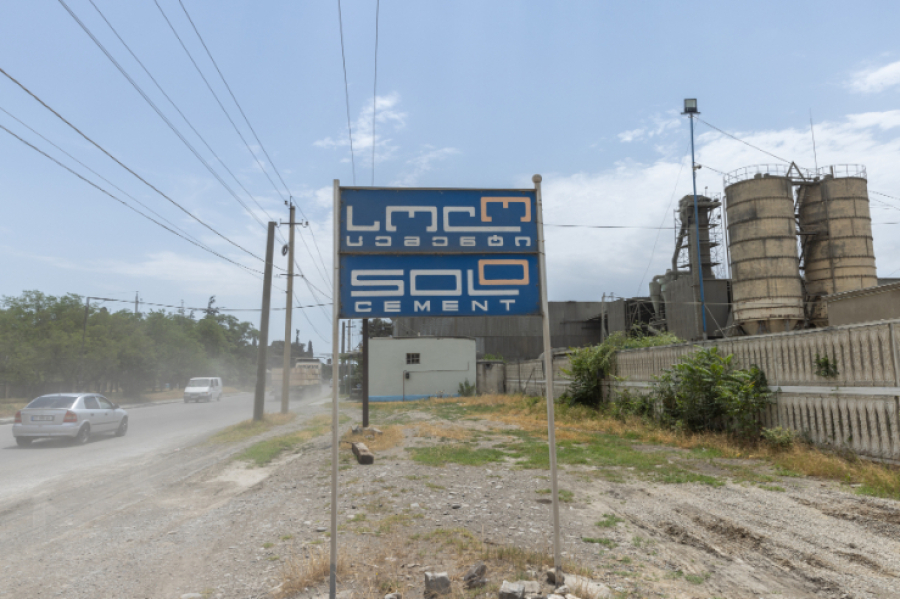
Among the largest enterprises are the Rustavi Metallurgical Plant (one of Georgia’s largest steel producers), Hunnewell Cement (former HeidelbergCement Georgia), and Rustavi Azot, one of the Caucasus region’s leading producers of fertilizers and industrial chemicals. Other notable factories include the Max Import, Solo, and Mshenebeli 2004 cement plants, the Geosteel steel mill, and the MnChemical Georgia plant, which specializes in producing manganese compounds.
Because many of these businesses had long relied on outdated technologies and failed to invest in environmental protection measures, their operations placed a significant burden on the environment. In recent years, following pressure from civic initiatives, in particular Gavigudet (We Are Suffocating), most factories have installed filtration systems. However, industry remains the main source of air pollution in Rustavi — responsible for up to 97% of particulate matter (PM) emissions, as well as large releases of nitrogen dioxide (NO₂) and sulphur dioxide (SO₂). As a result, Rustavi has consistently ranked among Georgia's most polluted cities, particularly in terms of particulate matter (PM10 and PM2.5). A large part of the Rustavi-born pollution transfers to Tbilisi, as Georgia’s capital is located in the same valley.
Smoke from factories often did not only come out of chimneys, but from leaking factory halls too, that do not have controlled ventilation with air filtration. Thus, unorganized, diffuse emissions escaped directly into the air and spread throughout the city. Rustavi residents then complained about the pervasive smell of metallurgy, nitrogen, and silicone. Workers from the factories reported they were often exposed to such dense air pollution indoors that visibility is reduced to less than half a metre, and many work without any protective equipment.
Despite the unhealthy conditions, residents are often afraid to speak out – around 8,000 people work in Rustavi’s factories, and their entire families depend on their income. Due to the economic situation, the fear of losing a job often outweighs concerns for health and safety.
In 2018, the Gavigudet civic initiative was established, bringing together Rustavi residents dissatisfied with the air quality. The activists initially approached the management of several factories to demanded improvements but were ignored. As a symbolic protest, they wrote the message “We Are Suffocating” directly on the wall of one of the factories.
Polluted air under citizens’ watch
Until 2019, there was no air pollution monitoring station installed in Rustavi. Only after pressure from citizens did the National Environment Agency (part of the Ministry of Environmental Protection and Agriculture of Georgia) start measuring air quality. The results were alarming. Concentrations of particulate matter (PM) exceeded the Georgian legal limit of 50 µg/m³ several times.
According to the World Health Organization (WHO), the recommended daily average for PM10 should not surpass 15 µg/m³. However, in Rustavi, measured values frequently exceeded both WHO and national limits. On the worst days, PM10 concentrations reached up to 300 µg/m³ – six times the Georgian limit and twenty times the WHO guideline.
Measurements also showed that out of the last 365 days, Rustavi experienced bad or very bad air quality on 281 days. In 2022, the PM10 limit was exceeded on more than half of the days. According to health studies, every 50 µg/m³ increase in PM10 concentration raises the risk of premature death from air pollution by 15%.
Since 2023, the official measurements are followed by the citizen air pollution monitoring network: AirGE, created in cooperation with GreenPole (Tbilisi), Arnika (Czech Republic) and AirBY (Belarus). Thanks to stations located around the city, it provides residents with up-to-date data and strengthens public control.
Meanwhile, Gavigudet activists began to document visible emissions and sharing the photos and videos of thick smoke rising from factories on social media. In response, some businesses shifted operations to nighttime hours to avoid public attention. However, pollutant concentrations published on the official state portal air.gov.ge showed that pollution was at its worst at night.
Thanks to pressure, Gavigudet managed to push through the creation of an official Action Plan to Improve Air Quality in Rustavi (2020-2022). The aim was to reduce industrial emissions, improve the traffic situation, expand green spaces, and raise public awareness issues.
However, the results were mixed. PM pollution decreased by 40 % in 2021, but concentrations were still above the established limits. Even a further 16% decrease in PM concentrations in 2022 did not lead to the achievement of the goals set in the action plan. Traffic emissions did not decrease at all; on the contrary, NO2 values in the monitored period did not drop to 40 µ/m3 but increased slightly from 55 µ/m3 to 56 µ/m3. The reason for not meeting all the targets in the action plan is due to insufficient supervision in companies, obligation of pre-announcing environmental inspections, and low value fines. Therefore, companies often ignore the rules set out by law.
Legal action for cleaner industry
The Gavigudet got involved in the creation of the Atmospheric Air Quality Management Plan for 2023-2025 for Rustavi and is striving for better legislative tools and public control. Its goal is not to close factories, but to enforce conditions that will not be detrimental to the health of residents.
Since 2019, the Gavigudet movement has attended dozens of public deliberations on technical documents, including scoping reports and Environmental Impact Assessments (EIA) for various industrial facilities. Together with residents, Gavigudet has raised concerns about the potential environmental and health risks posed by industrial expansion in the city. The movement has consistently pointed out significant gaps and ambiguities in official documentation, such as the absence of reliable emissions monitoring data and inadequate descriptions of filtration and waste management technologies. It has also highlighted inconsistencies between the claims presented in official reports and the real life experiences of residents - for instance, cases where reports state that factories operate only during the day, while residents report noise and activity during nighttime hours.
A significant achievement for Gavigudet was a partial victory in a three-year lawsuit against the Ministry of Environment Protection and Agriculture of Georgia and its subordinate body, the Department of Environmental Supervision. The court recognized in 2024 that state institutions had failed in their control responsibilities and ordered them to conduct regular inspections of enterprises in Rustavi, ensure their legal operation, including filtration and monitoring systems, and publish the results of emission measurements. However, the Ministry and the Department of Environmental Supervision appealed this decision in the Court of Appeals. Although the court did not award the plaintiffs financial compensation, its ruling still sets an important precedent: it confirms that state authorities can be held legally accountable for failing to carry out environmental oversight.